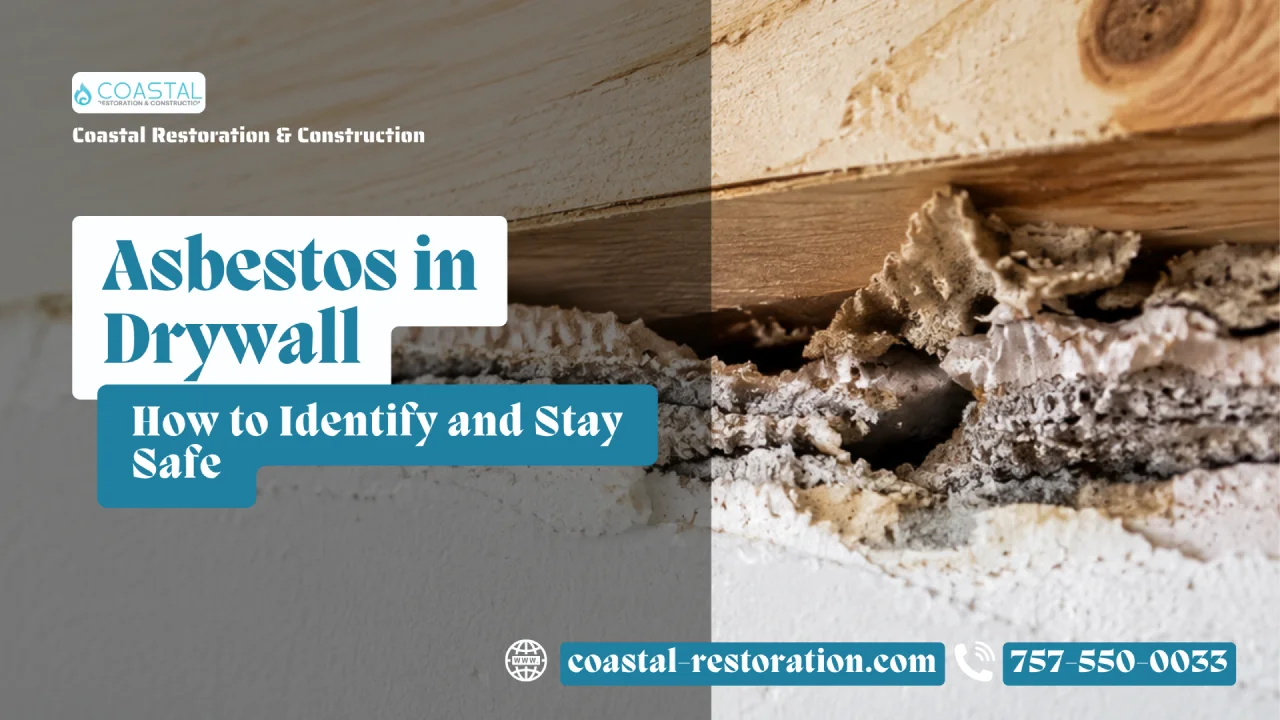
Most homeowners spend more time picking a paint color than wondering what’s inside the walls. A roller won’t disturb much. Cutting into one for new wiring is different, and that’s when the question hits: does drywall have asbestos? In plenty of older homes, yes. Just not where most people look.
Asbestos in drywall tends to hide in the mud smeared over the seams and screw heads. The gypsum board behind it is seldom the problem. Left alone under paint, that mud can sit there for decades without causing trouble. Sand it, saw it, or tear the wall out, though, and its fibers have a way into the air. If asbestos-containing materials are confirmed and need to be removed, asbestos abatement by trained professionals can help manage the risks and prevent the spread of airborne fibers.
Does Drywall Contain Asbestos?
Sometimes the board does. Far more commonly, the material spread over it does.
People who ask ‘can drywall have asbestos’ are usually picturing the panels themselves.
In a 1998 interpretation letter, OSHA noted that the wallboard itself seldom contains asbestos. The same letter points instead to the joint compound, spackling compound, and tape used to hide the seams and screw heads. In a house built or remodeled before 1980, those are the layers an inspector goes to first.

When Was Asbestos Used in Drywall?
Through the 1970s, the answer to ‘did drywall have asbestos’ was frequently yes, mostly in joint compound, where manufacturers added it to improve the mud’s working texture.
The Consumer Product Safety Commission banned it in consumer patching compounds, spackle and tape joint compound included, starting with products made or first sold after mid-January 1978 and covering all remaining stock after June 11 of that year. Compounds sold strictly for industrial use weren’t covered.
By the CPSC’s own estimate, about half the consumer patching compounds sold in 1977 still contained asbestos.
The build year is a decent first filter, but it isn’t the whole story. A 1955 house might have had its bathroom gutted and redone in 1990 while the living room still carries its original mud. Use the table as a rough starting point:
| When the walls were finished | Asbestos likelihood | Where to look first |
| Before 1978 | Highest | Joint compound, spackle, tape, texture |
| 1978 to 1980 | Lower, still possible | Industrial-grade compound, sprayed ceiling texture |
| After 1980 | Unlikely | Older patches left from earlier work |
(A rough guide based on federal rules and product history, not a test result.)
Where Asbestos Hides in a Drywall System
An old wall is built up in layers. Gypsum panel as the base, paper tape over each seam, a few coats of joint compound feathered across the tape and screw heads, and in some rooms a texture or skim coat on top. Standard sheets are four feet wide, so most rooms have a seam every four feet.

Asbestos Drywall Board: Less Common Than You’d Think
Of all the layers, the panel is the least likely to test positive. Unlikely doesn’t mean impossible, though, and nothing about a board’s appearance rules asbestos out.
Inspectors usually take full-depth samples on older walls, cutting through compound and board together so both get checked.
Asbestos in Drywall Mud and Joint Compound
This is where most of it lives. Joint compound came as dry powder or premixed in buckets. And before the late 1970s, plenty of both contained asbestos, mostly chrysotile. The amounts were small: Washington State’s Department of Labor and Industries puts typical drywall compound asbestos content well under 5 percent by weight. Small isn’t harmless, though.
Mud is everywhere on a wall: a stripe down every seam, a dab over every screw head. An inspector can sample it in a minute, and a pole sander can turn it to dust just as fast.
Drywall Tape, Texture, and Skim Coats
Paper joint tape belongs on the suspect list too. Textures are a bigger question. Think of a 1970s popcorn ceiling or a knockdown finish on a living room wall. Either one covers every square foot.
Any asbestos on drywall in that room runs corner to corner instead of hugging the seams. Same with a skim coat, where the mud goes over the whole wall.
OSHA files sprayed and troweled-on ceiling finishes under ‘surfacing material,’ and in any building constructed by 1980, it presumes that material contains asbestos until a test proves it doesn’t.
Asbestos in Sheetrock: Does the Brand Make a Difference?
Sheetrock is a brand name, United States Gypsum’s for more than a century, and it became everyday shorthand for drywall of any make. So the label on the back of a panel says little about asbestos in sheetrock drywall; the product and the year it went up decide that.
Since the board itself seldom contained asbestos, most cases of suspected asbestos in Sheetrock come down to the joint compound and tape used to finish it. If you suspect asbestos-containing materials in an older property, asbestos abatement may be necessary before renovation or demolition, depending on the material’s condition and whether it will be disturbed.
What Does Asbestos in Drywall Look Like?
Exactly like drywall without it. The EPA puts it simply: you can’t tell whether a material contains asbestos just by looking at it unless it’s labeled.
So ‘does old drywall have asbestos’ isn’t a question a flashlight can settle. The clues are circumstantial:
- A build date before 1980
- Original walls that were never replaced
- A popcorn or heavily textured ceiling
- Layer after layer of patching from past repairs
None of these proves anything on its own. They only tell you a test is worth ordering.
How to Tell If Drywall Contains Asbestos
Only a lab can answer ‘is there asbestos in drywall’ for your walls specifically. If they’re intact and nothing will disturb them, the EPA says you don’t need to test at all. Planning a remodel, a repair, or a flood cut? Then the test comes first, and two things are worth knowing.
Sending a Sample to an Accredited Lab
Don’t take the sample yourself. The EPA’s reasoning is blunt: a badly taken sample can do more harm than the wall would do sitting there untouched.
An accredited inspector mists the spot, cuts out a thumbnail-sized piece that goes through both the compound and the board, and seals it in a bag. At the lab, it goes under a polarized light microscope.
Ask whether the lab is accredited through NVLAP, the federal program the EPA points to. The EPA also suggests hiring an inspector who has no connection to whoever does the removal.
Why a Wall Can Test Positive and Still Fall Under 1%
This catches plenty of homeowners off guard. Under federal rules, anything over 1 percent asbestos counts as asbestos-containing material.
Say the joint compound in your hallway tests at 3 percent. If that mud was used only on the seams and screw heads, the EPA looks at panel, tape, and compound together as one wall system and recommends a weighted average of the three. Average a thin stripe of 3 percent mud into all that gypsum, and the wall as a whole can come out under 1 percent.
Two caveats. First, a skim coat doesn’t get averaged; the lab reads it as its own layer. Second, OSHA wants every material analyzed separately. One of its letters describes workers overexposed while sanding or tearing out old wallboard with no precautions.
When a drywall asbestos report comes back, check which method the lab used before you relax.
Is Asbestos Drywall Dangerous?
According to the EPA, asbestos material in good condition that won’t be disturbed generally doesn’t release fibers. The risk from asbestos in drywall shows up during a remodel. Sanding, sawing, drilling, scraping, tearing out: the EPA lists every one of those as a way fibers get released.
Dry, airborne fibers drift, which is why a proper crew tapes plastic over the doorways and shuts off the heating and cooling before touching anything.
The CPSC spelled out the stakes in its 1977 ban: breathing these fibers raises the risk of lung cancer and mesothelioma.
What to Do If Your Drywall Has Asbestos
A positive test calls for a plan more than panic. What comes next depends on the wall’s condition and whether a project will disturb it. Most situations come down to one of these three responses:
- Leave it alone when the wall is intact, and nothing’s planned
- If it’s damaged, have a trained professional seal or cover it
- Before a remodel or demolition, book professional removal
Plenty of drywall with asbestos has sat in houses since the 1970s without causing a problem. Removal is another matter. Oddly enough, federal law doesn’t require the people removing it from a detached single-family home to be trained or accredited. Some states and cities do, and the EPA tells homeowners to hire accredited crews either way.
A professional asbestos abatement crew works wet, packs every scrap into sealed, labeled bags, and leaves the room clean enough to pass an air test. Before arranging removal, homeowners should also consider asbestos abatement costs, as the overall expense can vary depending on the material, the affected area, and the complexity of the removal.
Water damage complicates all of this. After a burst pipe or a flooded basement, crews usually make a flood cut, removing the soaked bottom section of drywall in one straight line. In a house from the 1970s, that line can run right through asbestos joint compound.
OSHA took up exactly this situation in a May 2026 interpretation letter. Its answer: hanging new drywall against asbestos-positive wallboard or compound is covered by the asbestos standard, even if the old material is left in place.
FAQs
The same handful of questions comes up whether someone’s gutting a kitchen in a 1968 split-level or just hanging a shelf. Most come down to timing and testing. Quick answers to four of them follow. For anything specific to your own walls, a lab test is what to rely on.
Does old drywall contain asbestos?
Some do. Walls finished before 1978 deserve the most suspicion, mainly in the mud, spackle, and tape; OSHA says the board itself seldom contained asbestos. Unsure about yours? Then do what the EPA advises and assume it contains asbestos. Leave it alone until a professional has tested it.
Is it safe to drill or hang pictures on asbestos drywall?
Drilling is on the EPA’s list of things not to do with asbestos-containing material. If the wall hasn’t been tested and the house is old, give it the same respect. A light frame can go up on an adhesive hook. Cutting in a new outlet box is a different job, and it should wait for a test and a trained professional.
Can you sand old drywall mud?
Not until it’s tested. The EPA names sanding as one way asbestos fibers escape, and a sander on a finished wall goes after the joint compound first, the very layer in question. A positive result means putting the sander away and calling an abatement contractor.
Can drywall contain asbestos if it was installed after 1980?
Possible, but unlikely. The CPSC’s ban covered consumer patching compounds from 1978 on, and OSHA only presumes asbestos in sprayed or troweled-on finishes for buildings put up by 1980. Plenty of houses mix eras, though, with original 1970s walls beside newer additions.
Handling Asbestos in Drywall the Safe Way
Most of these walls will never cause a problem. The danger starts the day somebody decides to open one up, and by then it’s too late to wonder what’s in the mud.
Knowing how to tell if drywall has asbestos before the first cut is the cheap part. Cleaning up after a mistake isn’t.
If there’s a remodel ahead in a pre-1980 home, or a wall soaked by a leak, get the walls tested first. From there, Coastal Restoration & Construction can take care of the drying, the containment, and safe removal if the results call for it.