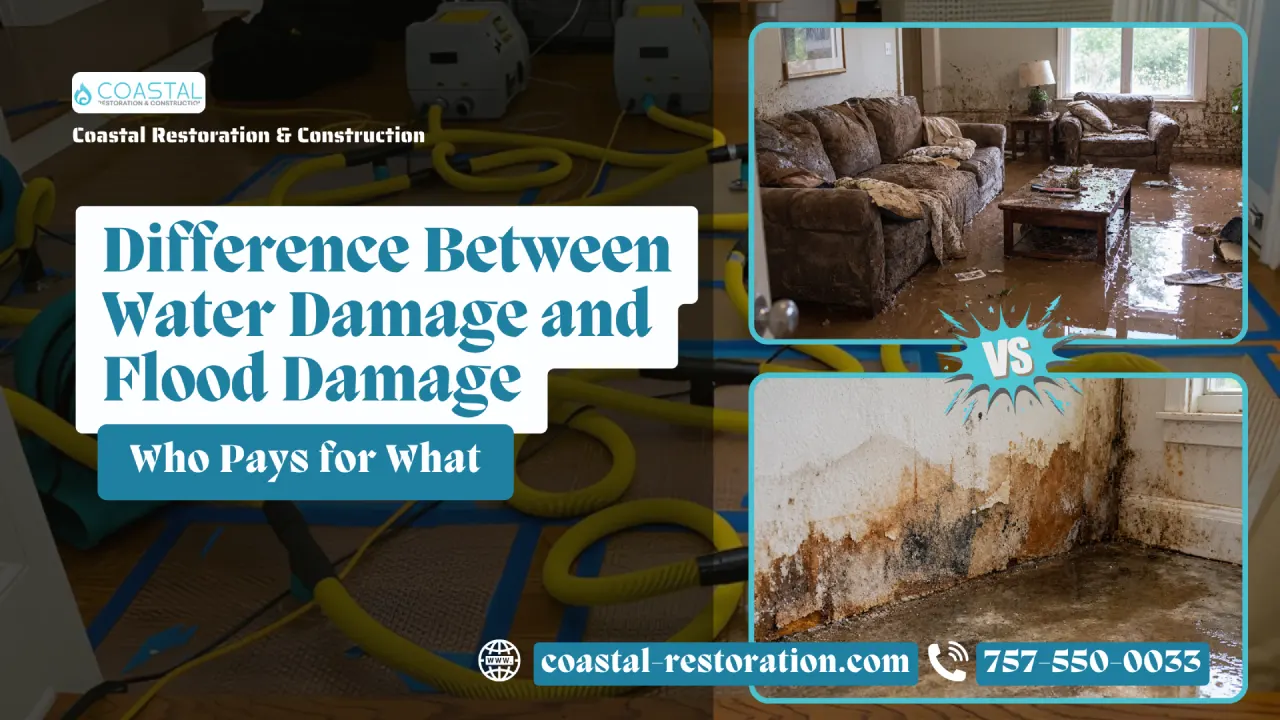
Take two houses on the same street, the Monday after a stormy weekend. In one, a supply line under the kitchen sink split overnight. In the other, the creek out back jumped its banks and pushed a foot of water into the living room.
Both owners are pulling up soaked carpet, and both would call it water damage. Their insurers won’t.
Their adjusters will start with one question: where did the water come from? The answer sits at the heart of the difference between water damage and flood damage. It points the claim toward one policy or the other, and it changes what a cleanup crew does once they’re inside. Sometimes it decides whether anyone pays at all.
Water Damage vs. Flood Damage, Side by Side
An adjuster and a restoration tech walking into the same wet house will check a lot of the same things first, starting with the source and how dirty the water is. The two kinds of damage usually compare like this:
| Water damage | Flood damage | |
| Where it starts | Inside the home: pipes, appliances, roof leaks | Outside: overflowing rivers, storm surge, heavy runoff |
| How far it spreads | Usually one home | At least 2 acres or 2 properties, under the NFIP definition |
| Typical water category | Clean at first (Category 1), but it can degrade | Category 3, contaminated |
| Usual coverage | Homeowners policy, if sudden and accidental | Separate flood insurance |
(A general comparison, not a coverage decision. How your own loss gets labeled depends on the exact wording in your policy and on what your adjuster finds.)
What Insurers Call Water Damage
Water damage, in the insurance sense, starts inside the house or comes in from above. A supply line splits behind the toilet. The tank on a ten-year-old water heater splits open.
Mid-cycle, a washing machine hose bursts at the fitting. Or a storm peels back a few shingles and rain comes through the ceiling.
None of that water crossed the yard to get inside. That detail carries a lot of weight in any flood vs. water damage call.
Timing counts as well. A split supply line qualifies, since homeowners policies generally pay for water damage that’s sudden and accidental, according to Texas A&M’s Real Estate Center. A drip that’s been rotting the subfloor for months usually doesn’t, and neither does water seeping in through the foundation.
What Is Considered Flood Damage, Exactly?
FEMA’s answer is more precise than most people expect. Its official definition calls a flood a general and temporary condition, with water spread over at least two acres of normally dry land or at least two properties. One of those properties has to be yours.
The water also has to come from the right place. Think of a river or tide spilling over, surface water piling up or running off unusually fast, or a mudflow.
The two-acre, two-property rule trips people up. Florida’s Department of Financial Services spells out the result: water that floods only one property doesn’t count as a flood under an NFIP policy unless it covers at least two acres. FEMA’s own claims training adds that the properties have to adjoin.

So when a creek overflows into your yard and the yards on either side, that’s a flood. A downpour that pools against your foundation and nowhere else probably isn’t, and that kind of water can slip between both policies.
Flood Damage vs. Water Damage: Three Ways to Tell Them Apart
Paper definitions are neat. Storm nights aren’t. Wind can rip open a roof while the street floods and a basement drain backs up, all before midnight, and suddenly one house has three kinds of water in it.
Three questions help untangle it, for adjusters and restoration crews alike.
Where the Water Started
Follow the water back to where it began. A pipe, an appliance, a hole the wind punched in the roof: those point to water damage.
Water that came in from outside and rose up from below points the other way. A creek over its banks, storm surge, rain sheeting off a parking lot faster than the storm drains can take it.
Ask whether the water ran across the ground before it got in. If so, you’re likely in flood territory.
How Far It Spreads
Water damage usually stays inside one home. A flood spills past the property line. The definition requires at least two acres or two neighboring properties.
So one house with a soaked basement after a storm doesn’t automatically count, even if the water came in from outside. If the yards next door stayed dry, the claim may be handled very differently.
How Contaminated It Is
Insurance pages tend to skip this part, but it drives the cleanup. Restoration crews grade the water before they touch anything, using a scale from the IICRC S500 standard.
Category 1 is the cleanest, like water from a split supply line. Category 3 sits at the other end. It’s grossly contaminated, and the standard puts seawater, rising rivers and streams, and surface water flowing indoors in that group.
Clear-looking floodwater fools people. It can still be carrying sewage, soil, and bacteria, and damage from a flood gets treated as Category 3 from the first hour.
A Category 1 leak can go bad too. Leave it sitting in the carpet and drywall long enough, and it can slide into a dirtier category.
Water Damage Coverage vs. Flood Insurance: What’s the Difference?
Plenty of people learn the difference between water damage and flood damage the hard way, on the phone with their insurer. Burst pipes and failed appliances go to the homeowners policy.
Rising water goes somewhere else entirely, since FEMA notes most homeowners policies don’t cover flooding. And some water falls between the two. Understanding water damage cleanup costs can help homeowners prepare for potential expenses associated with water extraction, cleanup, and restoration.
What a Homeowners Policy Will Pay For
A standard homeowners policy is built for sudden, accidental water: a pipe that bursts during a cold snap, or a dishwasher line that lets go while you’re at work.
Flood is a different matter. In insurance terms, it’s an “excluded peril,” as North Carolina’s Department of Insurance puts it. The policy lists it by name as something it won’t cover.
Maryland’s insurance regulator looked through policies from some of the biggest insurers in that state and found the same pattern. Virtually all of them exclude flood and surface water.
If you’re weighing flood insurance vs. water damage coverage, that exclusion is the first thing to find in your own policy.
Where Flood Insurance Comes In
Flooding needs its own policy, either through FEMA’s National Flood Insurance Program or from one of the private insurers that offer it.
NFIP limits for a house top out at $250,000 for the structure and $100,000 for what’s inside. Contents coverage usually isn’t included automatically with building coverage.
New policies typically carry a 30-day waiting period. A policy bought the day before the rain shows up won’t be in force when it arrives.
Skipping it because you’re outside a high-risk zone is a gamble, too: more than 30 percent of flood claims come from people outside those zones, according to FEMA. The agency also puts the damage from one inch of floodwater inside a home at more than $25,000.
Flood vs. Water Backup: Where Both Policies Fall Short
Then there’s the water that comes up through the floor drain.
North Carolina’s Department of Insurance is clear that a standard homeowners policy won’t pay when a sewer line or sump pump backs up into the house. Many insurers sell an endorsement that adds it.
That endorsement has its own limits, though. Maryland’s regulator notes it doesn’t extend to flooding or surface water.
Flood insurance pays for a sewer backup only when there’s a general condition of flooding in the area, the flood caused the backup, and a few other conditions are met.
Basement seepage follows similar rules under flood insurance. On the homeowners side, seepage is simply out, with no endorsement available to buy the coverage back, per the same North Carolina guidance.
Before assuming either policy pays, read both.
Cleaning Up Flood and Water Damage: Not the Same Job
A burst supply line caught early is mostly a drying job. Water extraction is the first step: remove standing water using suitable extraction equipment, then get air movers and dehumidifiers running. If drying starts quickly, much of what got wet can be saved.
Floodwater changes the job. Because it counts as Category 3, anything porous it soaked, like carpet pad or fiberglass insulation, usually ends up at the curb.
Wet drywall typically gets cut out to open the wall cavity, and the hard surfaces left behind are cleaned and disinfected.
Both jobs are on a clock. The EPA’s flood cleanup guidance draws the line at 24 to 48 hours. Whatever can’t be cleaned and dried in that window should be thrown out, since it can go on feeding mold long after the water’s gone.
Gear up before you start: the EPA lists gloves, boots, goggles, and an N-95 respirator for flood cleanup. Shut the power off at the panel first, if you can reach it without standing in water.
What to Do First After Water Gets In
The first few hours set up everything that follows, from the drying to the claim. FEMA’s guidance for flood claims is useful even if you’re not sure yet which kind of damage you have, so start here. You should also follow a drying guide to understand why prompt drying is important after water enters your home.
- Stop the water at the valve, and cut the power if it’s safe
- Get photos and video of every room before anything gets moved or tossed
- Save a swatch of the carpet, flooring, or wallpaper to show the adjuster
- Take a picture of the make, model, and serial number on ruined appliances
- Call the insurance company, then get drying started within 24 to 48 hours
Speed counts for another reason. Under FEMA’s rules, an NFIP policy won’t pay for mold that the owner did nothing to prevent.
FAQs
A few questions come up on nearly every water loss, usually while someone is standing in a wet hallway with a phone in one hand. Short answers to four of them are below. For anything specific to your claim, your policy and your adjuster have the final word.
Is flood damage the same as water damage?
Not for insurance purposes. Flood damage comes from outside, from overflowing water or runoff covering at least two acres or two properties.
Water damage begins inside the house, or comes in through the roof. Homeowners policies usually pay for that kind and leave floods out.
Will homeowners insurance pay for flood damage?
In most cases, no. FEMA says most homeowners policies leave flooding out, and state regulators like North Carolina’s treat it as an excluded peril.
You’d need a separate flood policy, usually through the National Flood Insurance Program. Buy it well ahead of storm season, since new policies typically don’t take effect for 30 days.
Is sewer backup considered flood damage?
Usually not. A sewer backup on its own is a separate kind of loss, and standard homeowners policies typically exclude it unless you’ve added a water backup endorsement.
Flood insurance covers a backup only when there’s a general condition of flooding in the area and the flood caused it, among other conditions.
So what’s the difference between water damage and flood damage insurance?
One is built into your homeowners policy and handles sudden, accidental water, like a burst pipe or a broken dishwasher line.
The other is a standalone flood policy for water rising from outside, capped through the NFIP at $250,000 for the structure and $100,000 for belongings. Having one doesn’t give you the other.
Sort Out the Difference Between Water Damage and Flood Damage Before You File
A lot of claim trouble starts with a fuzzy answer about the source. Know where the water came from before you pick up the phone. It tells you which policy to call and what kind of cleanup you’re facing.
A wrong guess can stall a claim for weeks, while the wet drywall keeps getting worse.
If water has already gotten in, whatever the source, the drying shouldn’t wait either. Coastal Restoration & Construction can handle the water extraction and drying while your claim moves forward.