The fire’s out. Trucks gone. And you’re standing in a house that smells like it burned, staring at walls that went grey overnight. Now what?
What is fire damage restoration? Everything between that moment and the day you move back in. Not just repairs. And how does fire damage restoration work? In a sequence, because smoke, soot, and the water the fire department left behind all do different damage, and the order you tackle them in changes what survives.
Here’s what this guide covers: what the work actually involves, what the fire did to the parts of your house that never burned, and what to do in the next 48 hours. If you need someone on site, our professional fire damage restoration services start with an emergency assessment.
What Does Fire Damage Restoration Involve?
Most people picture someone scrubbing black off a wall. That’s maybe a tenth of it.
So what does fire damage restoration involve? Four things, broadly. Stabilizing the building. Getting the smoke and soot out. Drying whatever the fire department soaked. Then rebuilding what’s gone.
Fire damage cleaning on its own doesn’t get you there. Neither does fire and smoke damage repair split across three contractors who never talk to each other, because that leaves gaps nobody catches until you’ve already moved back in.
Why Fire Damage Is More Complicated Than It Looks
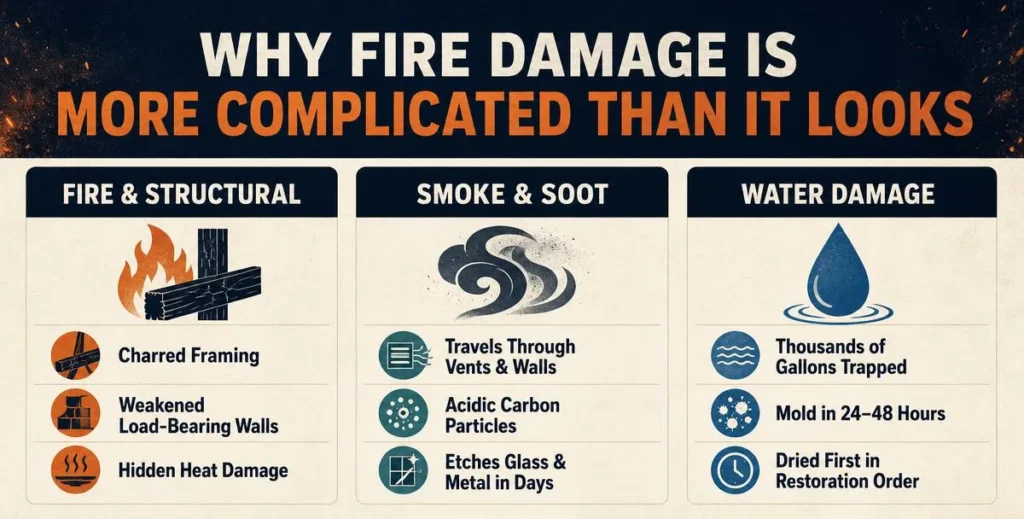
Three separate things happened to your house at once, and none of them gets fixed the same way. Flame, smoke, and water each need their own equipment and their own place in the schedule. Handle them as one job, and you’ll finish two of the three, then find the last one behind a wall six months later.
Direct Fire and Structural Damage
This is the damage you can see. Charred framing. Collapsed drywall. Floor you could put a foot through.
What you can’t see is whether the rest of it still holds. Heat travels, and it weakens wood and steel well past where the char marks stop, so a structural fire damage assessment goes into rooms that look completely fine. Load-bearing walls, joists, roof trusses. A fire-damaged property needs that sign-off before anyone starts nailing new drywall over an old frame.
Smoke and Soot Damage
Smoke doesn’t respect walls. It moves through vents, up inside wall cavities, under closed doors, into a closet at the far end of the house.
And soot isn’t dust. It’s carbon particles carrying oil and acid, and it keeps working the entire time it sits there. Give it a few days, and it etches glass, pits metal, and stains paint past the point of cleaning. So fire smoke damage turning up in a bedroom that never saw a flame isn’t strange. It’s typical. That’s why soot damage restoration covers the whole house, and why the smoke and soot removal process always starts dry, before any liquid touches a surface.
Water Damage from Firefighting Efforts
Then there’s the water. Hundreds of gallons, sometimes thousands, sitting in your subfloor and insulation and wall cavities. Mold gets going in 24 to 48 hours, so drying can’t wait until the soot is handled. It goes first. And there’s a practical reason for that order, not just a scheduling one.
The Fire Damage Restoration Process: Step-by-Step
The fire damage restoration process runs in phases, and each phase has to finish before the next one makes sense.
Go out of order, and you pay for the same work twice.
Soot on a wet wall is the example every crew gives. Wipe at it before the drying is done, and the residue goes into the material rather than off it. Now you’re replacing a wall you could have cleaned.
Most fire restoration damage crews work through something close to this:
- Emergency response. Somebody on site fast, a safety check before anything else, then stabilizing whatever’s unstable.
- Fire damage assessment and inspection, room by room, photographed as they go for the claim
- Board-up and tarping, so weather and anyone curious stay outside
- Water extraction, then drying. Pumps, air movers, dehumidifiers, and moisture readings taken until the numbers come back normal
- Soot removal, dry methods first, and which method they reach for depends on the soot type
- Odor work: thermal fogging, hydroxyl or ozone, and the ductwork
- Contents cleaning, on site where possible, packed out where it isn’t
- Reconstruction. Drywall, flooring, paint, and any structural rebuilding the assessment called for
Fire Damage Cleanup Checklist for Homeowners
The first two days decide a lot of what gets saved and what doesn’t. Professional fire cleanup begins when the crew shows up. The clock, though, started when the fire went out.
Do this first:
- Don’t go back inside until the fire department says you can. Embers can still be live inside a wall, floors can be weak, and wiring can be exposed.
- Call your insurer and open the claim. Some policies have a notification window.
- Photograph everything before you move a thing.
- Get a restoration company out for emergency stabilization.
- Keep receipts. Lodging, meals, anything you have to buy in the meantime.
Now the other half, which almost nobody tells homeowners. These four mistakes cost more than anything else on the list:
- Don’t wipe the soot. The big one. A cloth doesn’t lift soot off a surface; it pushes the oily part further in and drags the rest sideways. What good equipment could have cleaned on Monday is permanent by Wednesday.
- Don’t put water or household cleaner on it. Those react with the acid in the residue and set the stain for good.
- Don’t run the HVAC. It draws soot into the ductwork and pushes it into rooms the fire never got near. Open a window instead.
- Don’t throw anything out before the adjuster has seen it. No documentation, no reimbursement.
Can You Stay in Your Home During Fire Damage Restoration?
Sometimes. Depends on how far the smoke went and what’s still in the air.
Small kitchen fire, smoke contained, crew able to seal the work zone off from the rest of the house? You can probably stay. The air in a fire-damaged home carries particulates and chemical residue from burned plastics, paint, and synthetic fabric, so the question is really how much of that reached the rooms you’d be living in.
Multiple rooms burned, or the HVAC picked up contamination, and staying gets harder to justify. Same if somebody at home has asthma or a heart condition. A good restoration company will tell you straight which of those you’re looking at rather than leaving it to you to guess.
The Hidden Costs of DIY Fire Damage Cleanup
Trying to handle it yourself feels like saving money. It usually isn’t.
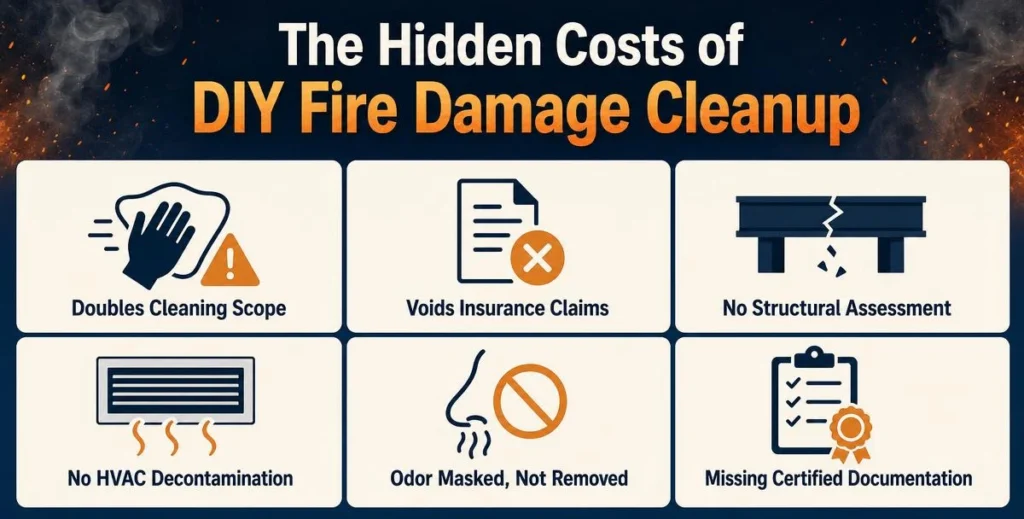
The soot problem alone is enough. One weekend of well-meant wiping can double the professional cleaning scope, because now the residue is embedded in surfaces that were salvageable on Monday. There’s a claims problem too. Most policies expect you to take reasonable steps to prevent further damage, so DIY work that makes things worse can complicate what your insurer will cover.
Then there’s what you can’t do at all. Structural assessment. HVAC decontamination. Molecular-level odor removal that actually works instead of masking. Certified fire cleanup services carry the equipment and the documentation for both homes and commercial fire damage restoration jobs, and that paperwork matters as much as the cleaning when the adjuster reviews your file.
Final Thought
Every hour that soot sits on a surface, it does a little more permanent damage. That’s the honest reason speed matters here, more than in almost any other kind of property loss.
So the first move isn’t cleaning. It’s getting someone qualified through the door to assess what you’ve got, stabilize the property, and document it properly for your claim. What you get back is a written scope, room by room, that your adjuster can work from instead of a rough phone guess. Our fire damage cleanup service handles all of it, from the emergency board-up through the final rebuild.
Frequently Asked Questions
How long does fire damage restoration take?
It varies a lot. A small kitchen fire might be one to two weeks. Widespread smoke damage or a structural rebuild runs anywhere from a month to several months.
Can smoke odor be removed completely?
Yes, when it’s done properly. Odor that lingers usually means something was cleaned but not sealed, or the ductwork was skipped. Masking it with air fresheners never holds.
Is it safe to clean soot myself before the crew arrives?
Better not to. Dry, loose debris you can sweep up. But wiping soot off walls or furniture almost always makes the job harder and more expensive.
Does homeowners insurance cover fire damage restoration?
Standard policies typically cover fire damage, though coverage limits and exclusions vary by policy. Open your claim early and document everything.